


Peptides in Aesthetic Medicine: Beyond the Hype, the Science Behind the Revolution
Peptides in Aesthetic Medicine: What the Clinical Evidence Actually Showsación
Dr. Jose Moreno Parra
7/2/20267 min read
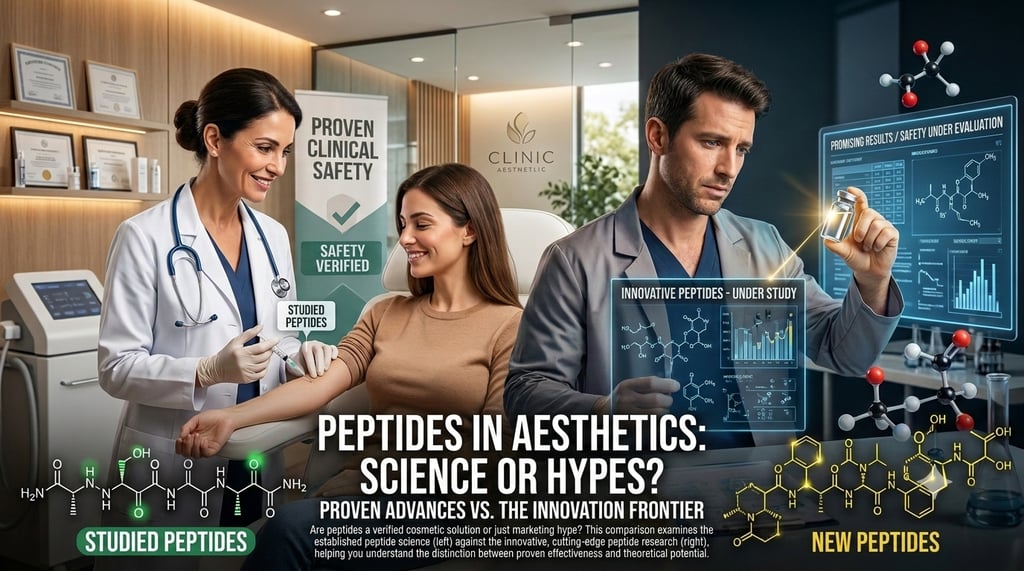
Peptides in Aesthetic Medicine: Beyond the Hype, the Science Behind the Revolution
Dr. Jose Moreno Parra | Samsara Sculpt & Renew | Medellín, Colombia
Why is everyone talking about peptides?
In recent years, the word peptide has made its way from biochemistry textbooks to social media feeds, aesthetic consultations, and premium pharmacy shelves. From the global surge in semaglutide (Ozempic/Wegovy) to GHK-Cu serums promising to reverse dermal aging, peptides have become the most sought-after ingredient in modern aesthetic medicine.
But what is driving this boom — marketing or real evidence? At Samsara, science guides every decision. That is why we are taking a rigorous look at what studies published in indexed journals — PubMed, Frontiers in Medicine, American Journal of Medicine, MDPI International Journal of Molecular Sciences — actually tell us about peptides and their role in medical aesthetics.
What is a peptide? The foundation you need to understand
A peptide is simply a short chain of amino acids — between 2 and 50 — linked by peptide bonds. They are natural signaling molecules: the body produces them to coordinate processes such as collagen synthesis, wound healing, hormonal regulation, and cell signaling.
What makes them exciting for aesthetic medicine:
High molecular specificity: they act on precise receptors with minimal off-target effects
Superior biocompatibility: safer profile compared to conventional small molecules
Biodegradable: they break down into amino acids, leaving no toxic residues
According to a 2025 review in the International Journal of Molecular Sciences (Zheng et al., IJMS 2025;26:5131), therapeutic peptides have undergone transformative advances in recent decades, with more than 80 approved peptide drugs and over 200 active clinical trials worldwide [1].
The four peptide families in cutaneous aesthetics
According to a 2025 review (PMC11762834), peptides are novel active ingredients that enhance collagen synthesis, promote skin cell proliferation, or reduce inflammation [3]. Based on their mechanism of action, they are classified into four groups:
Signal peptides: stimulate fibroblasts to produce collagen, elastin, and glycosaminoglycans. The most studied: Palmitoyl-KTTKS (Matrixyl®).
Carrier peptides: deliver active ions deep into the dermis. The prototype is GHK-Cu, which transports copper to areas of tissue remodeling.
Neurotransmitter-inhibiting peptides: modulate muscle contraction. Acetyl Hexapeptide-3 (Argireline®) shares a mechanism analogous to botulinum toxin but in topical form.
Enzyme-inhibiting peptides: block matrix-degrading enzymes such as metalloproteinases (MMPs).
Oral collagen peptides: what the RCTs actually show
A meta-analysis published in the American Journal of Medicine (2025) reviewed 23 randomized controlled trials involving 1,474 participants and found that collagen supplements significantly improved skin hydration, elasticity, and wrinkles. However, in the subanalysis by funding source, studies without industry sponsorship did not show significant benefit, and high-quality methodological studies did not reach significance across all parameters [4]. This finding matters clinically: the evidence exists, but it demands critical reading.
A double-blind, randomized, placebo-controlled trial evaluated low-molecular-weight collagen peptides (LMWCP) with Gly-X-Y tripeptide content >15%. After 12 weeks of supplementation at 1,000 mg/day (n=64), skin hydration values were significantly higher in the LMWCP group at weeks 6 and 12, and three wrinkling parameters along with the visual assessment score improved significantly versus placebo [5].
An RCT published in September 2025 (Journal of Microbiology and Biotechnology, Lee et al.) showed significant improvements in wrinkle depth, height, and visual severity scores across multiple facial regions at different time points in healthy adults supplemented with LMWCP [6].
GHK-Cu: the copper peptide that regulates over 1,000 genes
GHK-Cu (glycyl-L-histidyl-L-lysine copper) is a copper complex with the GHK peptide, naturally present in plasma, saliva, and urine, whose concentrations decline with age. Evidence shows it can stimulate synthesis of collagen, elastin, and glycosaminoglycans in the skin, with studies documenting reductions in fine lines and wrinkle depth after facial application [7].
A clinical trial with IRB approval (Yuvan Research, 2023, n=21 female volunteers) demonstrated an average 28% increase in dermal collagen density measured by high-resolution ultrasound after 3 months of daily application of a stabilized GHK-Cu gel. The top quartile of volunteers achieved a 51% increase [8].
A double-blind split-face study (n=60, ages 40–65, 12 weeks) compared a 0.05% GHK-Cu serum against placebo. Results showed a 22% increase in skin firmness and a 16% reduction in fine lines measured by optical profilometry; proteomic analysis confirmed upregulation of type I collagen and decorin, consistent with active dermal remodeling [9]. The tripeptide GHK-Cu was discovered in 1973 and has become a reference ingredient in skin treatments due to its protective and regenerative properties [10].
Argireline and topical neuromodulatory peptides
A randomized, placebo-controlled study evaluated the anti-wrinkle efficacy of Acetyl Hexapeptide-3 (Argireline®) and demonstrated statistically significant efficacy in adult subjects (Wang et al., Am J Clin Dermatol 2013;14:147–153) [11].
Raikou et al. evaluated the combination of tripeptide-10-citrulline and acetyl hexapeptide-3 in a prospective randomized controlled study, finding complementary effects in reducing dynamic wrinkles (J Cosmet Dermatol 2017;16(2):271–278) [12].
GLP-1 and metabolic peptides: the new aesthetic frontier
GLP-1 receptor agonists (GLP-1 RAs) have evolved from glucose-lowering agents into transformative therapies across multiple organ systems. A comprehensive 2025 review synthesizes the current evidence, concluding that GLP-1 RAs represent a paradigm shift toward multisystem therapeutic intervention [13].
The landmark Phase 3 trials include STEP-1 (NEJM, 2021), SURMOUNT-1 (NEJM, 2022), and SELECT (NEJM, 2023). Retatrutide, a triple agonist, achieved an average weight reduction of 22% at 48 weeks in a Phase II trial — the largest pharmacological weight reduction recorded to date (Jastreboff AM et al., NEJM 2023;389:514–526) [17].
The SEMALEAN study (n=106 patients, 68.9% women, mean BMI 46.3 kg/m²) evaluated the impact of semaglutide 2.4 mg on body composition, muscle function, and resting energy expenditure. At 12 months, mean weight reduction was 13%, with 59% of patients achieving ≥10% body weight loss [18]. A critical finding from an aesthetic-medicine standpoint: the accompanying loss of lean mass, which must be addressed with complementary body composition strategies.
From dermatology, a prospective observational study evaluated semaglutide's effect on acne severity, hidradenitis suppurativa activity, and sebaceous gland function between January 2023 and December 2024, documenting significant reduction in dermatological activity mediated through metabolic and anti-inflammatory pathways [19].
The issue the industry rarely mentions: skin penetration
At Samsara, clinical honesty is non-negotiable. A systematic review by Mortazavi et al. (2022) reached a clear conclusion: most anti-wrinkle peptides do not reach therapeutically relevant concentrations through passive topical application, due to their molecular size and hydrophilic nature [20].
Strategies that have shown the ability to overcome this barrier:
Microneedling: Li et al. (2015) demonstrated that pre-treatment with polymeric microneedle arrays increased GHK-Cu penetration approximately 8-fold compared to passive delivery, bringing the peptide to the dermal level where collagen-stimulating activity is most relevant [21]
Lipid-based transport systems
Thermodynamically stable ionic liquid microemulsions (Liu et al., Bioactive Materials, 2023): new pathways for optimized topical delivery of peptides [22]
This is precisely why at Samsara we combine peptide actives with physical protocols — microneedling, radiofrequency, biostimulating threads — that maximize dermal bioavailability.
Honest limitations and clinical perspective
As aesthetic physicians committed to science, we must acknowledge:
A large proportion of RCTs are industry-funded, which requires critical interpretation of results
Methodological heterogeneity between studies (dosing, duration, populations) limits direct comparisons
The gap between in vitro efficacy and real clinical outcomes persists, especially for topical peptides
Unapproved systemic peptides circulating outside medical contexts (BPC-157, TB-500, and similar) lack Phase 3 human clinical trials to support their use, despite the noise they generate on social media
Responsible aesthetic medicine does not sell promises — it translates evidence into protocols.
Conclusion: peptides are the future, but the present demands discernment
A 2022 market analysis valued the global cosmeceutical industry at USD 12.16 billion, with a projected compound annual growth rate of 8% through 2030 [23].
A 2026 systematic review and meta-analysis evaluated the efficacy and safety of oral and topical peptides for skin hydration, elasticity, wrinkles, and luminosity, with comprehensive searches across MEDLINE, CENTRAL, and Web of Science, confirming a solid scientific foundation while identifying methodological gaps for future research to address [24].
The peptide boom is not empty hype. There is a solid and growing scientific basis that positions these molecules as legitimate tools in the modern aesthetic medicine arsenal. From oral collagen peptides backed by multiple published RCTs, to GLP-1 agonists that have redefined body weight management with NEJM-level data, the peptide revolution has real substance.
What distinguishes a serious clinic from one that simply follows trends is exactly this: the ability to separate high-quality evidence from premature enthusiasm. At Samsara, we incorporate peptides into our protocols when the science justifies it — with the right dosage, route of administration, and clinical context.
References
Zheng B, Wang X, Guo M, Tzeng CM. Therapeutic Peptides: Recent Advances in Discovery, Synthesis, and Clinical Translation. Int J Mol Sci. 2025;26(11):5131. doi:10.3390/ijms26115131
Dávila-Hernández G et al. Therapeutic Peptides in Aesthetic, Metabolic and Endocrine Conditions. Int J Mol Sci. 2026;27(9):3890. doi:10.3390/ijms27093890
PMC11762834. Peptides: Emerging Candidates for the Prevention and Treatment of Skin Senescence. Int J Mol Sci. 2025 Jan.
Evans M et al. Effects of Collagen Supplements on Skin Aging: A Systematic Review and Meta-Analysis of Randomized Controlled Trials. Am J Med. 2025. doi:10.1016/S0002-9343(25)00283-9
Kim JA et al. Oral Intake of Low-Molecular-Weight Collagen Peptide Improves Hydration, Elasticity, and Wrinkling in Human Skin. Nutrients. 2018;10(826). PMC6073484.
Lee E et al. Skin Anti-Aging and Moisturizing Effects of Low-Molecular-Weight Collagen Peptide Supplementation in Healthy Adults. J Microbiol Biotechnol. 2025 Sep 11. PMC12438954.
Copper Peptide (GHK-Cu): Clinical Uses, Stability & Compounding Tips. Fagron Academy US. 2023.
Yuvan Research Inc. Epigenetic mechanisms activated by GHK-Cu increase skin collagen density in clinical trial. EurekAlert. May 2023.
GHK-Cu and Skin Remodeling: Updated Clinical Evidence. J Cosmet Dermatol. 2024.
Cho W et al. Exploring the Role of Tripeptides in Wound Healing and Skin Regeneration. Med Sci (Basel). 2025. PMC12595317.
Wang Y et al. The anti-wrinkle efficacy of argireline, a synthetic hexapeptide, in Chinese subjects. Am J Clin Dermatol. 2013;14(2):147–153.
Raikou V et al. The efficacy study of the combination of tripeptide-10-citrulline and acetyl hexapeptide-3. J Cosmet Dermatol. 2017;16(2):271–278.
Patel S, Niazi SK. Emerging Frontiers in GLP-1 Therapeutics. Pharmaceutics. 2025;17(8):1036. PMC12389369.
Wilding JPH et al. Once-Weekly Semaglutide in Adults with Overweight or Obesity (STEP 1). N Engl J Med. 2021;384:989–1002.
Jastreboff AM et al. Tirzepatide Once Weekly for the Treatment of Obesity (SURMOUNT-1). N Engl J Med. 2022;387:205–216.
Lincoff AM et al. Semaglutide and Cardiovascular Outcomes in Obesity without Diabetes (SELECT). N Engl J Med. 2023;389:2221–2232.
Jastreboff AM et al. Triple Hormone Receptor Agonist Retatrutide for Obesity. N Engl J Med. 2023;389:514–526.
Alissou M et al. Impact of Semaglutide on fat mass, lean mass and muscle function: The SEMALEAN study. Diabetes Obes Metab. 2025. PMC12673431.
Akbar M et al. The Impact of GLP-1 Agonists on Acne, Hidradenitis, and Sebaceous Activity. PMC. 2025. PMC12884193.
Mortazavi SH et al. Challenges and Strategies for Topical and Transdermal Delivery of Bioactive Peptides. Crit Rev Ther Drug Carrier Syst. 2022;39(1):1–31.
Li QY et al. Polymeric microneedle arrays increase GHK-Cu dermal penetration ~8-fold vs. passive delivery. 2015. (Cited in: RethinkPeptides Aesthetic Research Overview, 2026.)
Liu T et al. Thermodynamically stable ionic liquid microemulsions pioneer pathways for topical delivery and peptide application. Bioact Mater. 2023;32:502–513. PMC10643103.
Goldie K. The evolving field of regenerative aesthetics. J Cosmet Dermatol. 2023;22 Suppl 1:1–7.
Frontiers in Medicine. Oral and topical peptides for skin aging: systematic review and meta-analysis of randomized controlled trials. Front Med. 2026. doi:10.3389/fmed.2026.1618306